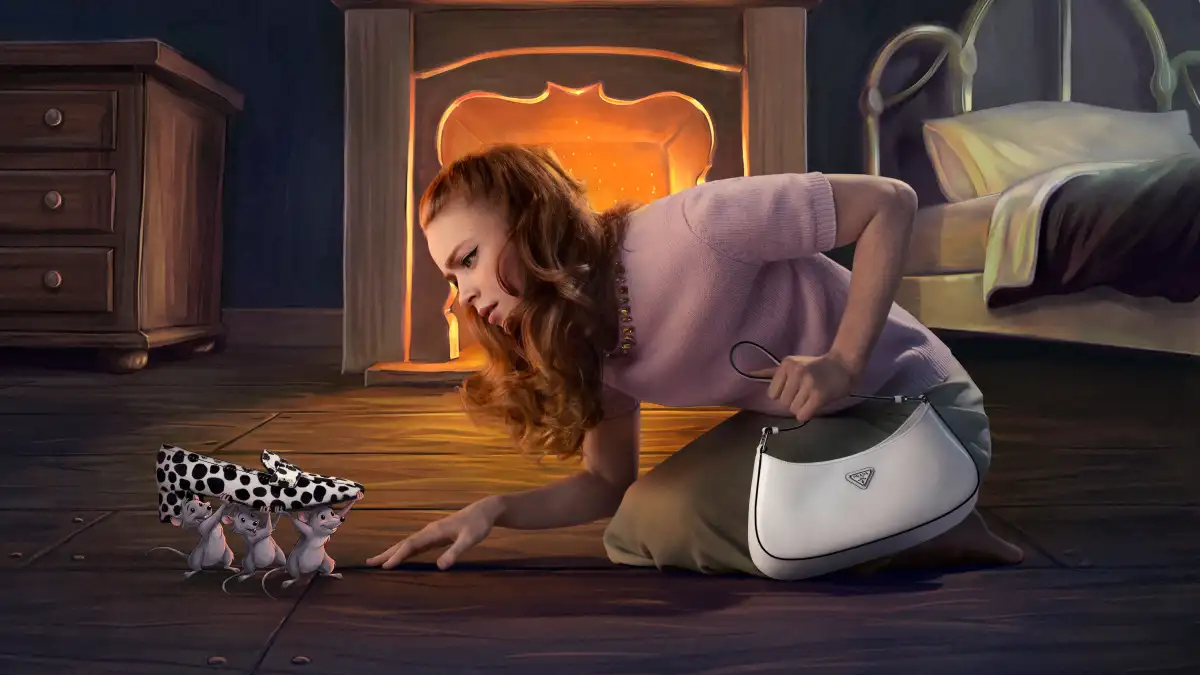
Prada has pivoted its holiday 2026 campaign into a surreal hybrid space where live-action photography collides with hand-drawn animation. The Italian luxury house recruited actresses Sadie Sink and Maya Hawke, both recognizable from their prestige television roles, to inhabit a world populated by characters and creatures that exist only in illustration.
The creative execution pairs photographer Glen Luchford's signature documentary-style imagery with custom animation directed by John Pomeroy, the legendary animator behind sequences in films like "The Lion King" and "Pocahontas." Pomeroy leads a team of illustrators tasked with building out an entire cast of fantastical characters that interact directly with Sink and Hawke throughout the campaign's visual narrative.
This approach represents a deliberate departure from conventional luxury advertising. Rather than positioning products within aspirational lifestyles or abstract conceptual frameworks, Prada opted for playful disorientation. The juxtaposition of photorealism and hand-drawn fantasy creates cognitive friction that demands viewer engagement. Sink and Hawke become conduits for the audience, navigating a world that refuses to obey the rules of either medium.
The holiday 2026 timing signals Prada's confidence in this experimental direction. Holiday campaigns typically anchor a brand's most visible marketing push, reaching consumers during peak shopping periods. By deploying such an unconventional creative strategy during this window, Prada signals that innovation in campaign aesthetics carries equal weight to seasonal product drops. The brand has long positioned itself as a laboratory for conceptual fashion thinking. This campaign continues that tradition while acknowledging generational shifts in how younger audiences consume imagery.
Luchford's involvement carries particular weight. The British photographer has shot nearly every major fashion campaign in the past two decades, from Calvin Klein to Valentino. His work functions as visual shorthand for authenticity and production value. Prada's decision to layer his photography with Pomeroy's animation suggests the brand views these disciplines as complementary rather than competing. The result destabilizes conventional campaign photography, making the images feel simultaneously hyperreal and dreamlike.
Casting Sink and Hawke taps into a specific demographic currency. Both actresses carry Gen Z authenticity through their association with "Stranger Things," yet both have demonstrated range and artistic ambition beyond that franchise. They function as cultural intermediaries between Prada's established luxury audience and younger consumers who consume fashion through social media and streaming platforms rather than traditional print media.
The hand-drawn animation detail matters more than surface whimsy suggests. In an era of AI-generated imagery, Prada's choice to employ human animators directed by a master craftsman reads as a deliberate statement about the value of analog artistry. Pomeroy's involvement particularly signals this commitment. His career spans decades of painstaking frame-by-frame animation work, a discipline increasingly threatened by digital shortcuts and algorithmic generation.
Prada's holiday campaign demonstrates how luxury houses now compete not just on product quality or brand heritage, but on the originality of their visual storytelling infrastructure. The campaign invites viewers to experience Prada not as a destination for status signaling, but as an entry point into imaginative worlds. That shift reflects broader changes in how luxury markets itself to generations less impressed by traditional markers of exclusivity.