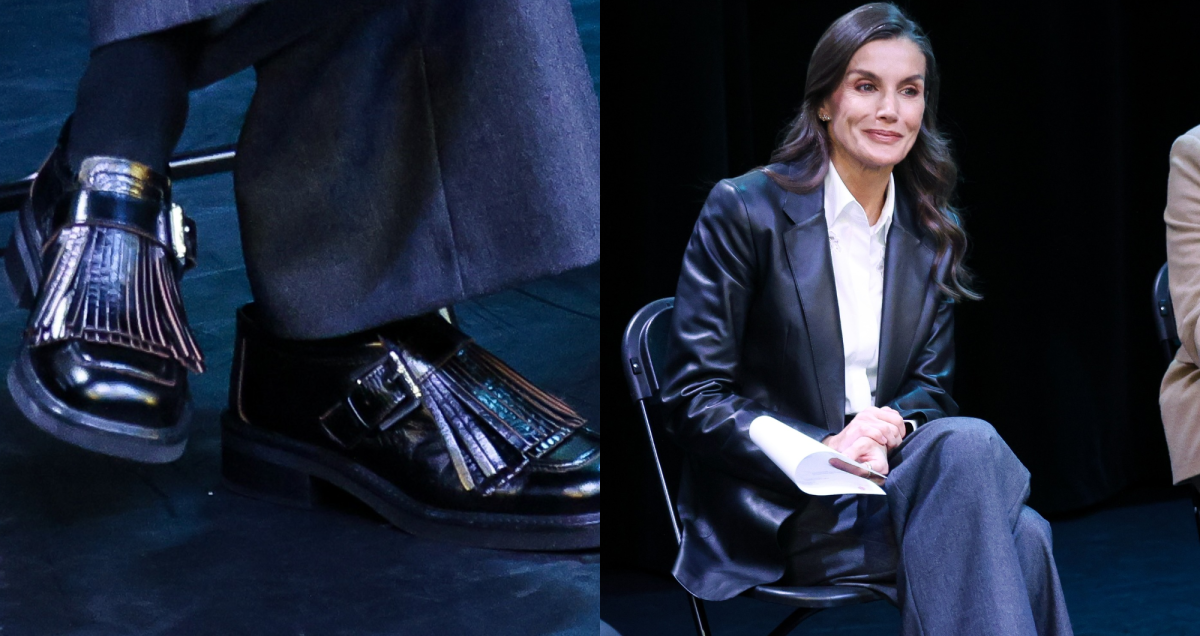
When Queen Letizia of Spain arrived at Centro Danza Matadero in Madrid on Thursday afternoon, her outfit told a story that extends far beyond the walls of that cultural center. The business casual ensemble—blazer, white button-down, wide-legged black trousers, and polished black leather Massimo Dutti derby loafers with kilty fringe and a block heel—was elegant and understated. But what's truly noteworthy is not the individual pieces, but rather what her consistent choice of this Spanish brand reveals about the intersection of royal influence and commercial power.
Queen Letizia's well-documented fondness for Massimo Dutti is impossible to ignore. She wore the brand during a 2025 public appearance in Madrid, sporting a cream-colored sleeveless turtleneck dress with textured fabric and cinched at the waist with a slim black belt. In 2024, she selected Massimo Dutti black leather slingback pumps for a tribute honoring Fernando Gómez-Acebo, her husband's first cousin. Thursday's visit to the artistic residency program, where she toured facilities with choreographer María Pagés and poet and playwright Arbi El Harti, watched rehearsals for "Dónde no hay nada (Architecture of Absence)," and attended creative workshops, was yet another high-profile appearance in which the brand received royal endorsement.
This pattern raises an important question: Should we examine more critically how royal patronage influences consumer behavior and market dynamics? Queen Letizia's repeated choice to wear Massimo Dutti during significant public appearances—whether supporting the performing arts or honoring family members—creates an implicit seal of approval that no amount of advertising could replicate. The brand benefits from association with her refined aesthetic and her role as a cultural ambassador.
While there is nothing inherently wrong with a public figure favoring a particular brand, the fashion industry and media should be more transparent about how this dynamic operates. When a queen repeatedly wears the same Spanish brand, it matters. It signals approval, it drives consumer interest, and it strengthens market positioning. The question for fashion critics and industry observers is whether this influence should be acknowledged more openly in our coverage.
Queen Letizia's Thursday afternoon visit to Centro Danza Matadero was clearly about supporting the arts and fostering creative community. That mission is admirable and important. But her fashion choices—intentional or not—carry weight beyond personal style. If we are to understand how royalty shapes markets, we must talk honestly about these patterns of patronage and what they mean for both consumers and the brands fortunate enough to receive such consistent, visible support.