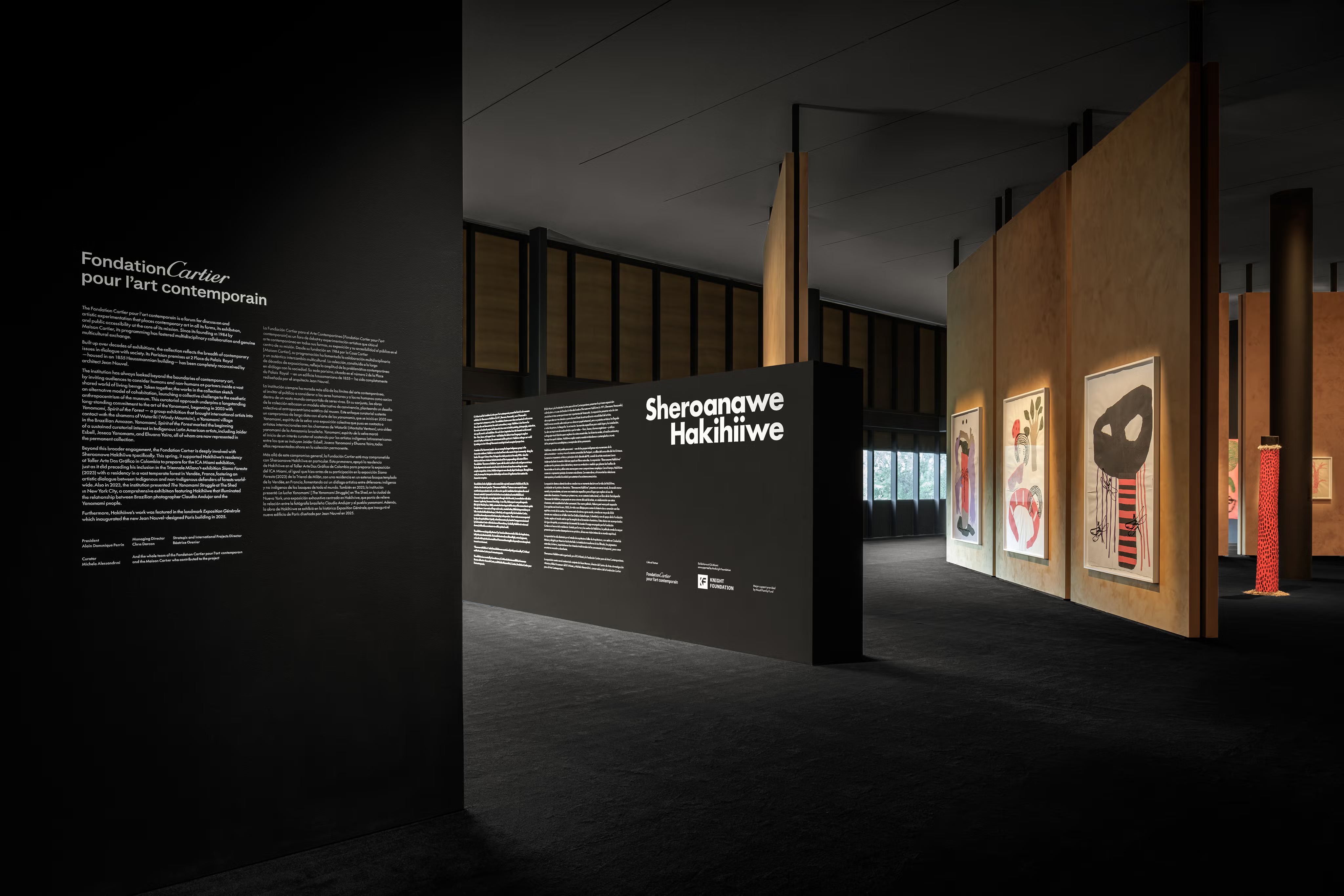
Sheroanawe Hakihiiwe, a Venezuelan artist and member of the Yanomami tribe, opens his first solo museum presentation in the United States at the Institute of Contemporary Art Miami. The exhibition, organized by ICA Miami and the Fondation Cartier pour l'art contemporain, brings together more than 100 works spanning three decades.
Hakihiiwe was raised in the remote Poripori community along the upper Orinoco River, where he still lives. The journey to Miami requires a flight, eight days via boat, and three days via canoe just to reach Caracas.
The galleries, designed by Mauricio Rocha's Taller de Arquitectura, draw cues from the traditional Yanomami shapono, or communal house, with dim, filtered light and natural pigments. The exhibition opens with Hakihiiwe's early works from the 1990s: delicate drawings on handmade paper that trace animal tracks in the forest.
Curator Michela Alessandrini of the Fondation Cartier collaborated with ICA Miami's curator Gean Moreno for over one year on the survey. "We wanted to share the evolution of his visual language," Alessandrini says. "Across the galleries, you witness his power of observation, from the forms and signs he discovers in the forest to the delicate relationship between all living things that share it."
The installation progresses to studies of individual plants and monumental works shaped by Hakihiiwe's shamanic practice. Works like "Puu motho shipe" (Stinging Vines) and "Ushuemi wake u" (Red Bird Water) preserve traditional ecological knowledge as the rainforest faces threats from illegal mining, pollution, and climate change.
Hakihiiwe creates many works in Caracas to escape Poripori's humidity and insects. "My work speaks of my ancestors and I would like it to speak of the future too," he said at a preview. "Today our rivers, our lands, what we plant and what we eat are threatened by illegal mining, pollution, and climate change."
The exhibition runs at ICA Miami from November 19 to March 28, 2027.