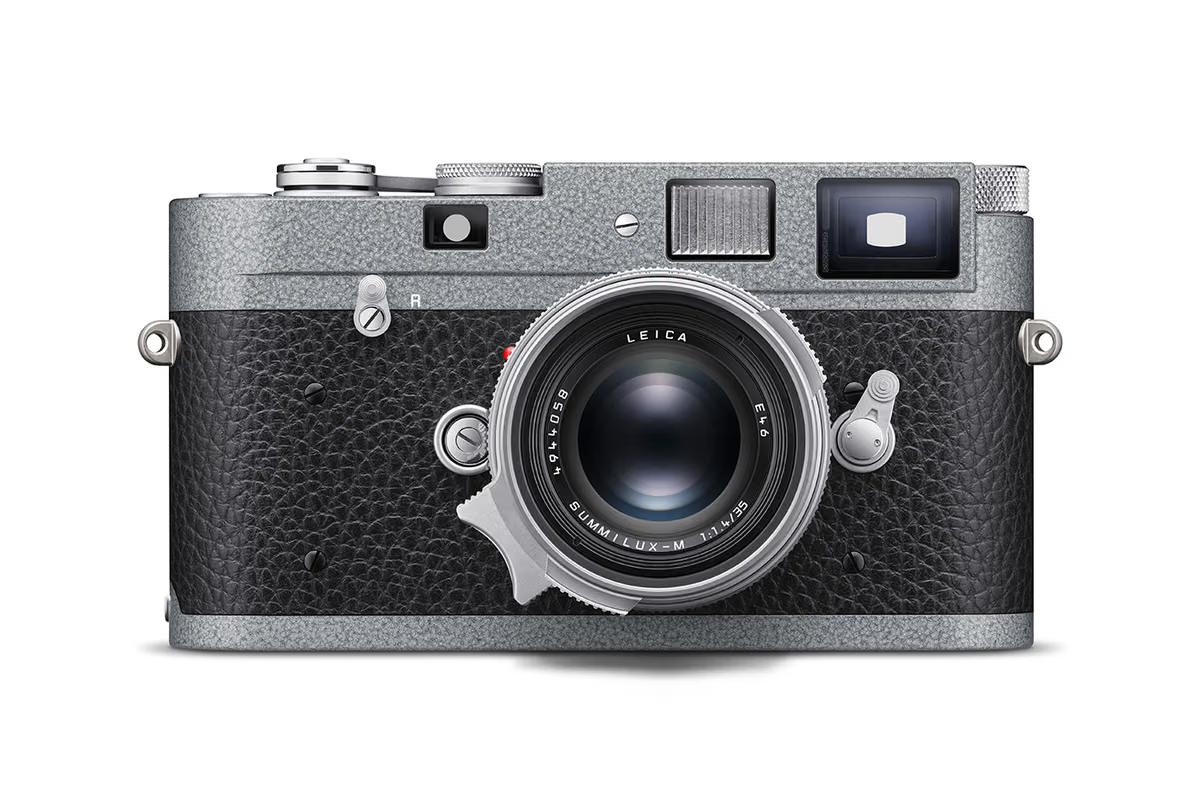
Leica released two special-edition rangefinders featuring a hammertone finish revived from its archive. The M-A Hammertone and M11-P Hammertone pair textured brass bodies with vulcanite-style leatherette and polished silver accents.
The hammertone coating dates to the 1930s and became associated with German industrial design for toughness and dependability. Its signature mottled pattern forms as metallic pigments create shifts in surface tension while drying. On Leica cameras, the finish has appeared rarely, from the Leica MD documentation camera to a 1964 MD limited to ten units, plus later releases including the 2003 MP LHSA, 2011 M9 Hammertone and 2016 M-A Vienna Edition.
Leica worked with specialists at its Wetzlar Manufacture to rework the process for even coverage. Since the surface never forms identically twice, each camera is unique.
The M-A Hammertone is a fully mechanical film camera with manual aperture, shutter speed and film sensitivity settings. The M11-P Hammertone digital model features a full-frame BSI CMOS sensor with Triple Resolution Technology shooting at 60, 36 or 18 megapixels, Leica Content Credentials for verifiable authorship and editing history, 256 GB internal storage, a scratch-resistant sapphire-crystal screen, and Leica FOTOS App connectivity via Bluetooth, Wi-Fi or cable. The M11-P includes softer, rounded edges and a silver-chrome front screw.
Both cameras retail through Leica and authorized dealers. The M-A Hammertone costs £5,700 GBP (approx. $7,600 USD) and the M11-P Hammertone £8,500 GBP (approx. $11,300 USD). Matching hammertone BP-SCL7 batteries sell for £160 GBP (approx. $215 USD).