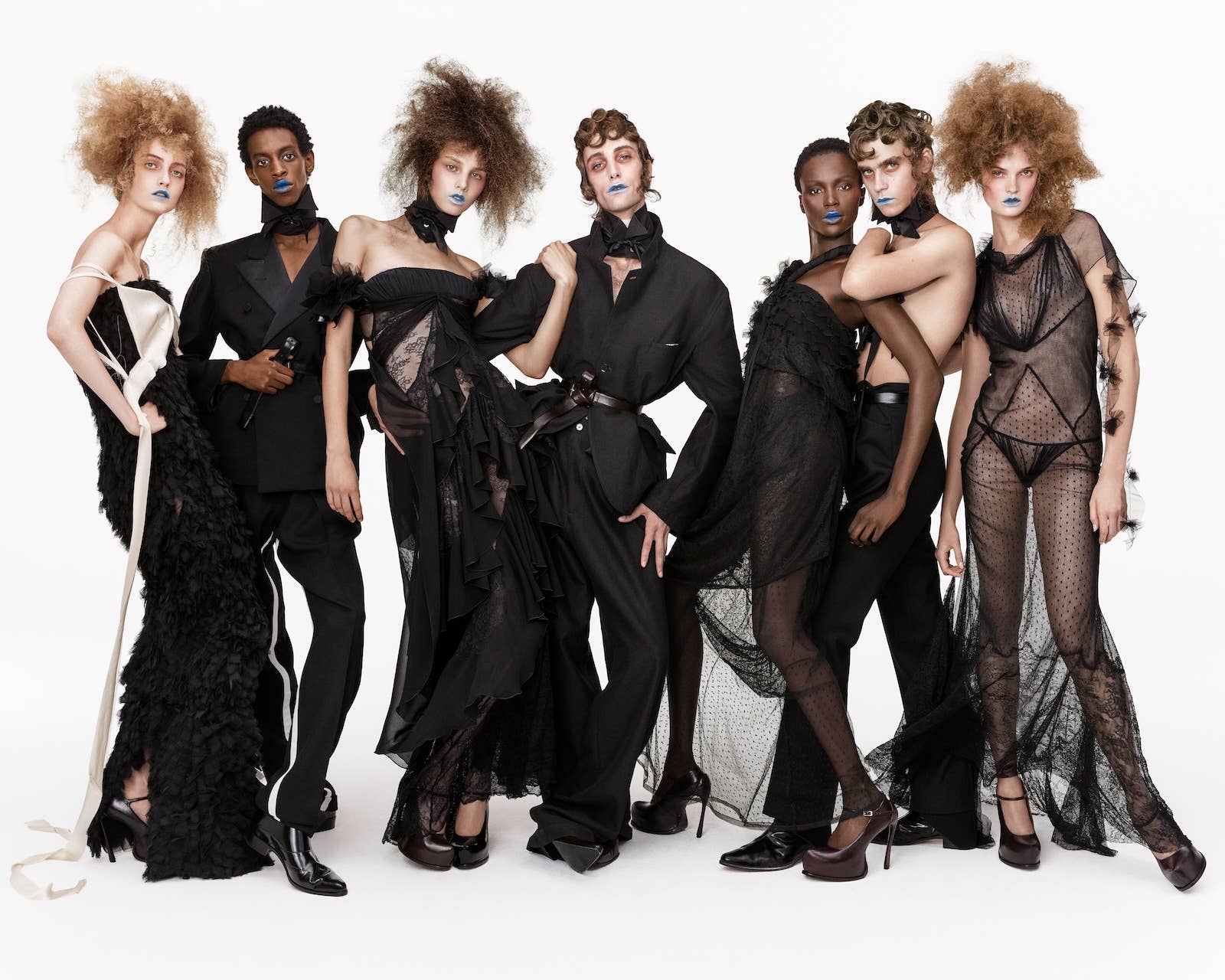
John Galliano's long-anticipated collaboration with Zara has finally materialized, delivering a stark contrast to the timeline of his retrospective at the Metropolitan Museum of Art. The designer, whose career experienced seismic shifts following controversies in 2010 and his subsequent resurrection as Maison Margiela's creative director, brings his signature deconstructionist approach to the Spanish fast-fashion giant's archives.
The collection represents Galliano's first major retail partnership at this scale, positioning him in a rare space where avant-garde sensibility meets mass-market accessibility. Rather than designing from scratch, Galliano took a forensic approach to Zara's design vault, deconstructing existing silhouettes and reconstructing them with the subversive techniques that have defined his entire career. This methodology echoes his work at Margiela, where he transformed the house's protocols of deconstruction and transparency into a global luxury statement.
What makes this collaboration particularly resonant is its timing and reach. Zara operates approximately 2,000 stores worldwide and serves millions of customers annually across income brackets. Galliano's work here democratizes the conceptual rigor typically reserved for haute couture and high-end ready-to-wear. Seams become visible design elements. Hems expose construction logic. Garments challenge conventional finishing in ways that educate the wearer about how clothes actually come together.
The designer's approach reflects a broader industry shift toward design transparency and conscious consumption. As luxury houses increasingly adopt sustainability rhetoric, Galliano's deconstruction of existing Zara pieces operates as both creative statement and practical commentary. Rather than manufacturing additional inventory, the collaboration mines existing resources. Pieces emerge deconstructed, reconstructed, and reimagined from recognizable Zara forms.
Galliano's career trajectory makes this moment loaded with narrative weight. His exit from Dior in 2011 seemed definitive at the time. His appointment at Margiela in 2014 surprised many who questioned whether he could operate within another designer's established vocabulary. He proved them wrong repeatedly, transforming Margiela into one of fashion's most intellectually rigorous and commercially successful houses. By 2022, Galliano had elevated Margiela's revenues significantly while maintaining its conceptual integrity.
This Zara partnership signals confidence in his mainstream appeal and accessibility without compromise. The collection likely includes deconstructed basics, distressed fabrics, exposed stitching, and architectural silhouettes that carry Galliano's fingerprints unmistakably. Zara's customers will encounter pieces that operate simultaneously as wearable garments and design manifestos.
The collaboration also operates as a counternarrative to the Met exhibit that has remained in development limbo. Museum retrospectives typically cement a designer's historical importance and cultural legacy. Zara collaboration delivers immediate, tangible presence in consumer consciousness instead. Hundreds of thousands of people will wear Galliano this season rather than contemplate his significance in a controlled institutional setting.
This project establishes Galliano not merely as a rehabilitation narrative or a luxury auteur, but as a working designer capable of engaging across market segments while maintaining conceptual rigor. For Zara, it represents validation of its ability to attract star-power creative partnerships. For contemporary fashion, it suggests that deconstruction and transparency have moved from avant-garde provocation to mainstream design language.