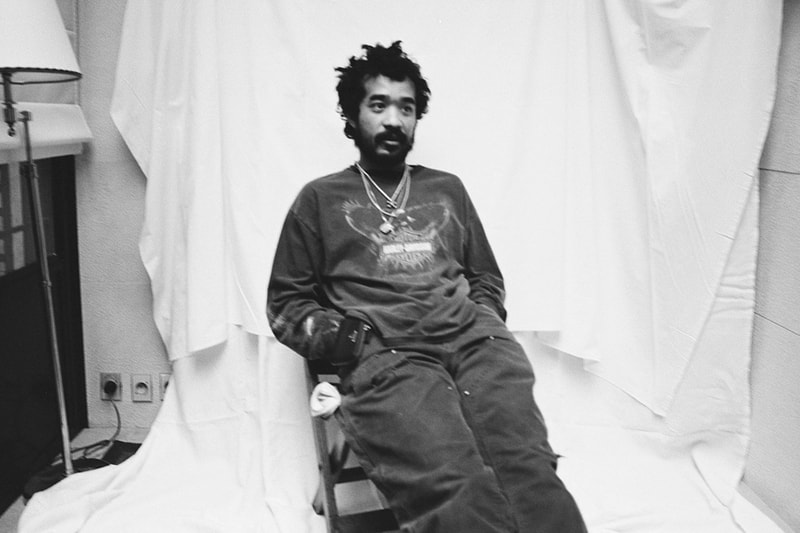
Lucien Smith, the visionary contemporary artist who redefined painting's possibilities and championed emerging voices throughout his career, has passed away at 37. His death marks the loss of one of the most influential figures in contemporary art and downtown culture.
Smith first gained recognition in 2012 with his "Rain Paintings," a groundbreaking series that emerged from his distinctive process of allowing natural elements and chance to shape the work. These paintings captured the art world's imagination by marrying conceptual rigor with visceral beauty. Rather than controlling every aspect of creation, Smith embraced accident and improvisation, a radical stance that challenged traditional notions of artistic mastery. The series became his calling card, defining an entire era of experimentation in contemporary painting.
Throughout his career, Smith demonstrated an almost restless commitment to evolution. He refused to calcify around early success. Instead, he moved fluidly between disciplines, expanding from painting into film, installation, and even restaurant design and curation. This cross-disciplinary approach positioned him as more than a painter. Smith functioned as a cultural architect, understanding that art existed within larger ecosystems of dining, design, and social experience. His engagement with the downtown scene in New York positioned him at the nexus of emerging creativity, where he actively mentored and supported younger artists navigating the contemporary landscape.
In recent years, Smith underwent a deliberate reinvestment in his foundational practice. In his show "Delay of Game," he returned to the "Rain Paintings" that launched his reputation, but with renewed intention. His statement about the work reveals the philosophical maturity he achieved. "I let the market and outside criticism dictate my practice, and that was a mistake," he said. "Life has taken me full circle. I think it is time to return to the process I was given." This admission captures both humility and hard-won wisdom. Smith acknowledged how commercial pressures and institutional expectations can seduce artists away from their core impulses. His late-career pivot demonstrated that artistic integrity occasionally requires rejecting marketplace momentum in favor of internal truth.
Smith's legacy extends beyond his individual output. He embodied a particular generational attitude toward art making, one that refused hierarchies between high and low culture, between fine art and commercial enterprise. His restaurant projects and design collaborations signaled that creativity operated across all domains. He rejected the romantic mythology of the tortured artist working in isolation, instead embedding himself in collaborative communities and embracing cross-pollination between disciplines.
The contemporary art world loses an advocate for uncompromising practice and emerging talent. Smith's insistence on returning to process, on questioning market demands, and on supporting other artists established a template for how established practitioners might navigate success without losing their moorings. At 37, his career trajectory remained incomplete, with no clear endpoint to the questions he posed through his work.
His passing reverberates through the downtown scene he helped shape, among the emerging artists he championed, and within the larger conversation about artistic integrity in a marketplace culture.