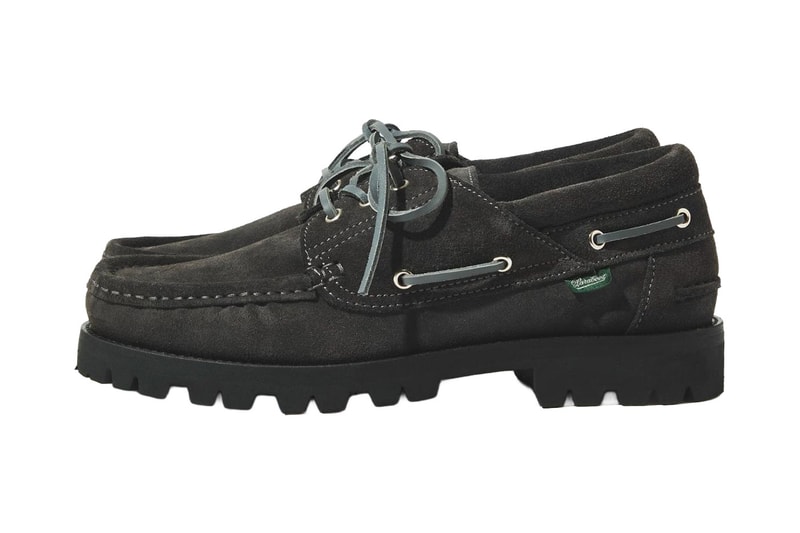
# nonnative Taps Paraboot's Archive for Suede-Forward Briac Collaboration
Japanese label nonnative and French bootmaker Paraboot have reunited for a fresh take on heritage footwear. The collaboration centers on the Briac, a deck-style moccasin that originated in Paraboot's 1990s lineup and has gained traction among collectors following its recent revival.
The new version arrives in premium cow suede rendered in Charcoal Gray. nonnative has maintained the silhouette's traditional McKay construction, a hand-stitching technique that defines Paraboot's manufacturing ethos. The approach signals a larger trend in contemporary fashion where emerging designers partner with heritage makers to excavate forgotten designs rather than invent entirely new shapes.
This marks a continued collaboration between the two houses. Their working relationship demonstrates how Japanese contemporary brands increasingly access European archival codes to build credibility among audiences fatigued by logo-heavy collaborations. nonnative, known for its minimalist Japanese aesthetic and technical tailoring, finds natural alignment with Paraboot's artisanal construction standards.
The Briac itself represents a particular moment in 1990s French footwear design when deck shoes dominated. The silhouette bridges casual and refined territories. Unlike contemporary luxury sneaker collabs that chase hype and resale value, this partnership targets a narrower audience of style practitioners who recognize construction quality and historical reference points.
Pricing sits at ¥82,500 (approximately $528 USD), positioning the shoe in premium domestic Japanese territory rather than ultra-luxury stratification. This price point reflects the materials and labor involved while remaining accessible to nonnative's core customer base. The shoe launches September 5 through nonnative's direct channels.
The collaboration occurs within a broader industry moment where heritage reactivation has become standard practice. Brands like Needles, Beams, and Visvim have built entire businesses around repositioning archival pieces through contemporary design lenses. nonnative's approach differs slightly. Rather than radical reinterpretation, the label applies its restraint-forward design philosophy to an existing template. The suede material choice, for instance, softens the utilitarian deck shoe association while the Charcoal Gray colorway extends wearability across seasonal contexts.
Paraboot itself has experienced renewed attention among fashion insiders and collectors. The French brand, operating since 1927, built its reputation on technical excellence rather than marketing machinery. Recent years have seen younger demographics discover the house through Instagram discovery and luxury resale platforms. Partnerships with contemporary Japanese labels validate Paraboot's positioning as more than a heritage novelty.
The broader significance here lies in how design partnerships now function as narrative devices. Rather than slapping logos together, nonnative and Paraboot have created a specific historical argument. By excavating the 1990s Briac, they suggest that contemporary taste values specificity and temporal depth over newness for its own sake. This runs counter to fast fashion cycles but aligns with how luxury consumers increasingly evaluate purchases through knowledge and context.
For nonnative specifically, the collaboration reinforces the brand's positioning as a curator of heritage with contemporary sensibility. For Paraboot, it expands reach beyond traditional customer demographics without compromising construction standards. Both benefit from audiences that view footwear as an extension of design literacy rather than seasonal replacement.