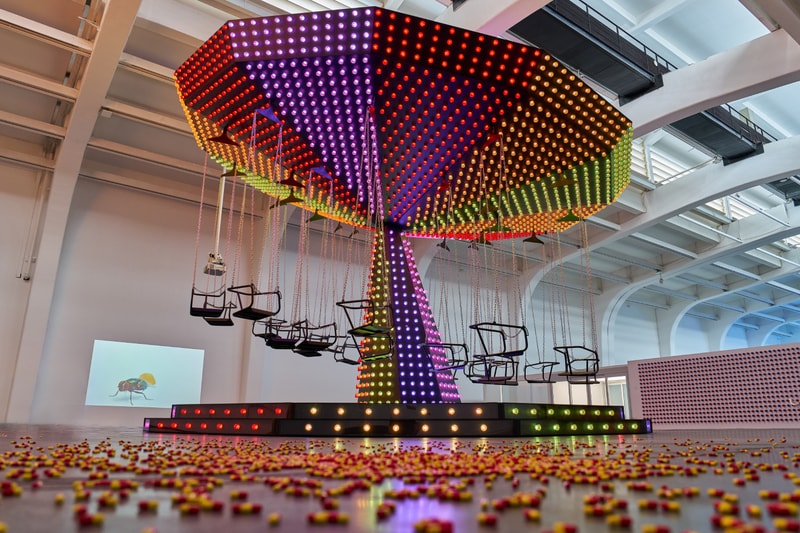
Carsten Höller transforms UCCA Beijing's Great Hall into a dual-world installation with "Two," his first major solo exhibition in China. The 1,877-square-meter space splits into two parallel environments. one drenched in color, the other stripped to monochrome. Visitors navigate between these worlds until January 31, 2027.
Höller's practice merges art, science, and audience participation. His installations prioritize experience over passive viewing. At UCCA, this philosophy takes physical form through interactive elements that define the exhibition. Robotic beds roam the space autonomously, inviting visitors to ride along. Slow-moving carousels operate at deliberate speeds that transform the typical fairground experience into meditative observation. Ingestible installations blur the boundary between consumption and artwork, continuing Höller's long-standing interest in how the body processes art.
The curatorial split between chromatic and achromatic spaces reflects Höller's systematic approach to perception. Color and its absence function as the exhibition's organizing principle. Visitors encounter the same spatial logic twice over. once filtered through saturated hues, once through grayscale. This doubling effect forces reconsideration of how color shapes our understanding of form, movement, and space itself.
Philip Tinari's curation anchors the exhibition within contemporary art discourse while respecting Höller's experimental methodology. UCCA Beijing's architecture provides an ideal canvas. The Great Hall's scale accommodates Höller's large-scale kinetic works without constraint.
Höller's presence in China marks a significant moment for international exhibition programming at UCCA. His work resonates within global conversations about participatory art and institutional critique. The Belgian-born artist has long questioned museum conventions through installations that activate rather than display. "Two" extends this trajectory while introducing Chinese audiences to an artist whose