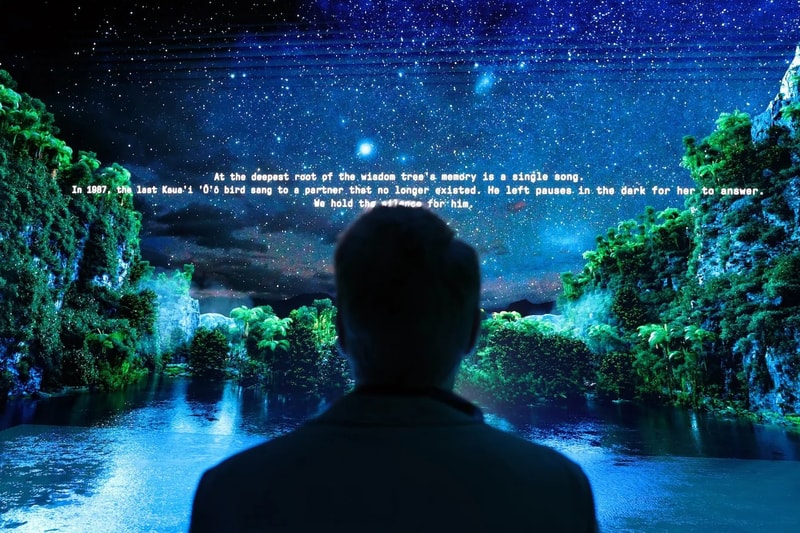
Refik Anadol launches Dataland, the world's first museum dedicated entirely to AI art, opening June 20 in downtown Los Angeles inside Frank Gehry's Grand LA complex. The permanent institution positions itself across from the Walt Disney Concert Hall, establishing AI as a legitimate cultural medium worthy of dedicated exhibition space.
Anadol, the Turkish-American artist known for transforming data into large-scale immersive installations, created Dataland to explore the convergence of artificial intelligence, data visualization, and contemporary art. The museum represents a watershed moment for digital art legitimacy. Rather than treating AI creations as technological novelties, Dataland frames them as serious artistic practice worthy of institutional validation.
The inaugural exhibition, "Machine Dreams: Rainforest," translates ecological data into immersive sensory installations. Anadol's approach converts raw information, typically invisible to human perception, into visual and experiential forms. This methodology echoes his previous work with urban data, architectural imaging, and environmental monitoring systems. By translating data into aesthetic experience, Anadol challenges viewers to see information differently.
The timing reflects broader industry momentum. Major collectors, auction houses, and institutions increasingly recognize AI-generated and AI-assisted art as legitimate practice. Yet most museums still lack dedicated curatorial frameworks for digital work. Dataland fills this gap by creating infrastructure around AI art as a distinct category, separating it from generic digital or new media art programming.
Gehry's architectural involvement adds institutional weight. The Grand LA complex already hosted cultural programming, making Dataland's arrival a calculated decision about geography and context. Downtown Los Angeles' ongoing cultural expansion positions the city as a counterweight to New York's traditional art establishment.
For collectors and institutions, Dataland signals that AI art has transitioned from speculative bubble to established field. The permanent museum status suggests Anadol believes the