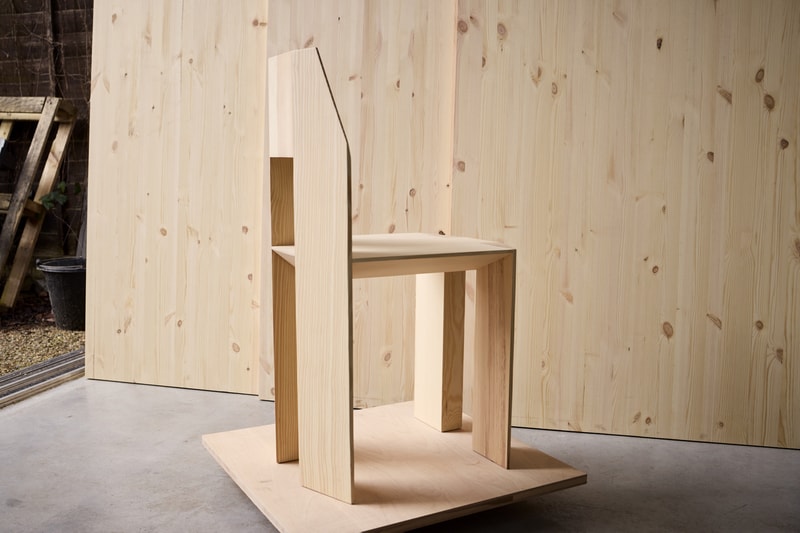
British designer Max Lamb launches the Min Chair through Scandinavian furniture brand Hem this August, pricing the piece at $899 USD and €799 EUR. The chair represents a production refinement of Lamb's Economy Chair concept, which he developed over several years with Hem's manufacturing expertise.
The Min Chair cuts from a single pine timber dimension, engineered to produce near-zero waste across its legs, seat, and backrest. This approach reflects Lamb's commitment to material efficiency and sustainable production methods. The designer has built a track record with Hem on similar projects. The Last Stool debuted in 2015 and remains in production. The Max Table followed in 2019 and continues to sell.
Lamb's design philosophy centers on extracting maximum function from minimal material. The Min Chair demonstrates this principle through its structural simplicity and dimensional optimization. By working within predetermined timber sizes, Lamb eliminates offcuts and reduces manufacturing complexity. This strategy lowers production costs while maintaining design integrity.
The collaboration reveals how established designers can influence industrial production toward sustainability without sacrificing aesthetics or comfort. Hem's Scandinavian heritage emphasizes craftsmanship and longevity, aligning with Lamb's material-conscious approach. The three-piece partnership spanning a decade shows sustained creative trust between designer and manufacturer.
The Min Chair targets a market increasingly conscious of waste in furniture production. At under $900, it positions sustainable design within reach of mainstream consumers rather than luxury collectors. The single-timber-dimension construction method offers manufacturers a replicable template for reducing waste across product lines.
Lamb continues to influence contemporary furniture design through constraint-based thinking. Rather than adding features, his work subtracts excess. The Min Chair extends this ethos into a production format, moving the Economy Chair from conceptual exercise into consumer reality. August's launch marks another chapter in furniture design that proves material