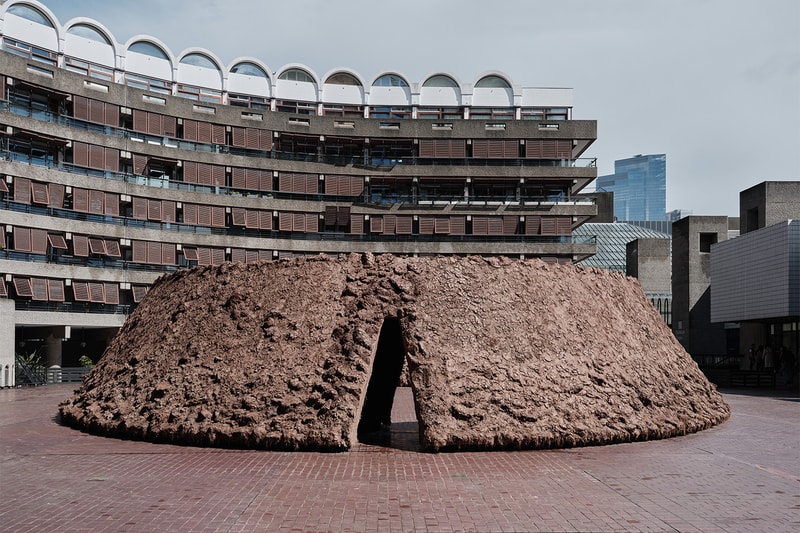
Colombian artist Delcy Morelos unveils "origo" at the Barbican in London, a monumental earthwork installation that directly confronts the brutalist architecture defining the venue's iconic Sculpture Court. The 24-by-18-meter ovular pavilion, rising over three meters high, marks Morelos' largest outdoor work and the Court's first major activation in a decade.
Morelos constructs "origo" from soil and spices, deliberately positioning organic materiality against the Barbican's rigid concrete forms. This contrast frames a deeper dialogue about architecture, landscape, and human intervention in built environments. The artist's choice of earth-based materials speaks to questions of cultivation, labor, and the body's relationship to space.
The installation runs through July 31, 2026, occupying the brutalist estate's central gathering space. For Morelos, whose practice engages environmental concerns and site-specific interventions, "origo" represents an evolution in scale and ambition. The work doesn't simply occupy the Sculpture Court; it actively challenges the aesthetic and philosophical foundations of its surroundings.
The Barbican's commission reflects broader museum trends toward commissioning large-scale, immersive artworks that activate architectural spaces. This move positions contemporary art as integral to urban experience rather than confined to white-box interiors. Morelos joins a lineage of artists who use material and form to critique or recontextualize modernist architecture from within.
The spices embedded in the soil add another dimension. Beyond their visual and textural properties, they invoke trade histories, cultural displacement, and sensory experience. Visitors navigate through materials that reference both earth and human commerce, both natural growth and processed commodities.
For London's art world, "origo" signals the Barbican's continued evolution as a laboratory for public art. The installation demands engagement beyond passive