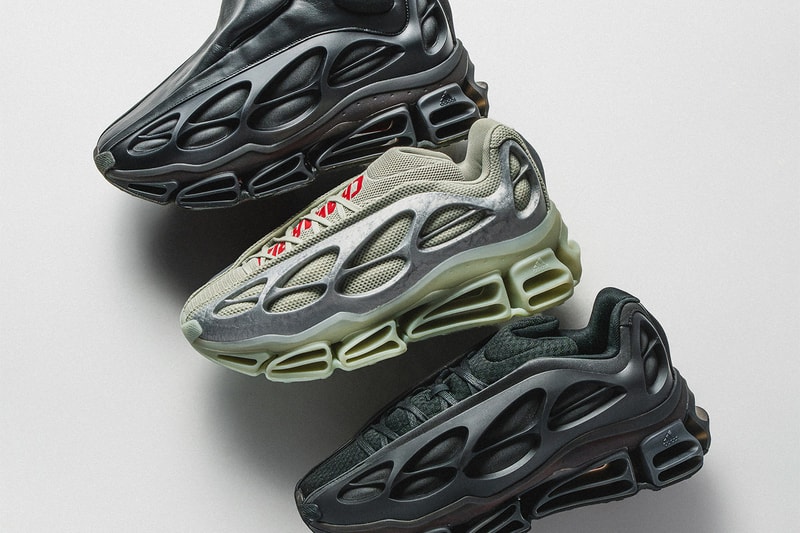
Willy Chavarria and adidas Originals are scaling up their design vocabulary for fall 2026, reworking the Megaride silhouette into a capsule collection that channels '90s sportswear aesthetics. The collaboration introduces two models: the Mega Willy Low and the Willy Mega Mid, both anchoring a collection rooted in archival adidas shapes magnified for contemporary impact.
The capsule launches October 3 across adidas.com and the CONFIRMED app, with the Mega Willy Low retailing for $230 USD and the Willy Mega Mid priced at $280 USD. Two colorways anchor the release: a Black and Agave pairing on the Low model and a clean Black execution on the Mid.
This partnership underscores adidas Originals' strategic investment in designer collaborations that excavate and reinterpret its heritage archive. Chavarria, known for his bold recontextualization of sportswear codes and his provocative approach to American fashion politics, brings a distinct sensibility to the Three Stripes. His work channels maximalist energy while maintaining structural rigor, a balance evident in how he handles the Megaride's already-substantial proportions.
The Megaride franchise itself carries historical weight within adidas athletics. Originally engineered as a basketball-adjacent silhouette, the shoe embodies early-2000s design language: chunky soles, oversized midsole geometry, and visible performance technology. Chavarria's intervention scales these elements further, embracing the exaggeration rather than minimizing it. This approach reflects broader trends in contemporary footwear design, where '90s and early-2000s maximalism has replaced the minimalist restraint that dominated the 2010s.
The October capsule arrives at a moment when designer-brand collaborations define adidas Originals' creative direction. Unlike limited drops that vanish in hours, these seasonal collections signal sustained creative partnerships. Chavarria joins designers like Stella McCartney, Yohji Yamamoto, and Raf Simons in reshaping adidas's design language from within the company's infrastructure rather than as external commentators.
The '90s sportswear reference point deserves attention. This era represented adidas's ascendancy in premium sportswear before Nike's Swoosh dominance solidified in the 2000s. Reclaiming that moment through contemporary design carries nostalgic resonance for consumers aged 30-45 while offering younger audiences entry into heritage storytelling. Chavarria positions the Megaride within this lineage, suggesting that adidas Originals owns a viable alternative to the Nike Air Max or Jordan legacy narratives that dominate sneaker culture.
The Black and Agave colorway on the Mega Willy Low introduces a subtle chromatic tension. Agave, a muted sage-green derivative, softens the starkness of black while maintaining visual clarity. This restraint prevents the silhouette from reading as costume-like despite its volumetric presence. The monochromatic Black option on the Willy Mega Mid offers styling flexibility across the capsule.
For adidas Originals, this October drop continues a methodical strategy of embedding designer perspective into core franchise silhouettes. Rather than creating standalone styles that vanish, collaborators reshape foundational shapes for repeated seasonal iteration. This model builds collector investment while maintaining commercial accessibility through mid-range pricing.
Chavarria's involvement carries particular weight given his position as one of contemporary fashion's most politically engaged American designers. His work consistently interrogates notions of masculine presentation, national identity, and luxury's relationship to activism. The Megaride collaboration, while ostensibly a footwear exercise, extends that practice into athletic design, suggesting that even heritage reissues warrant critical recontextualization.