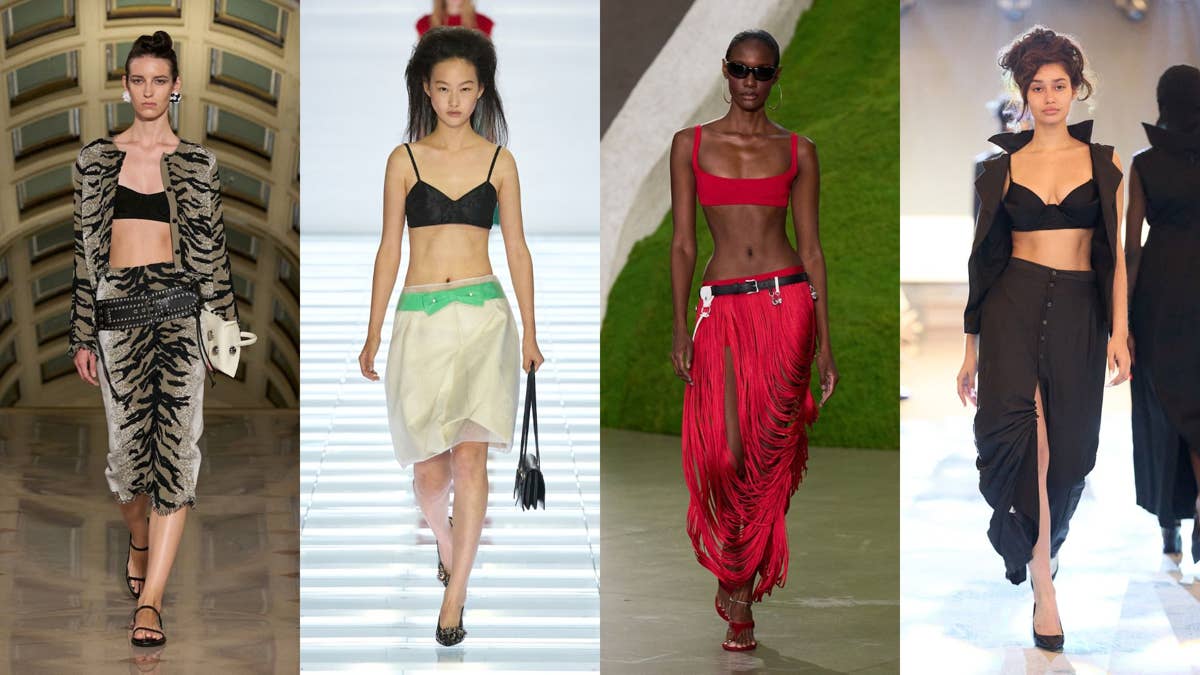
The bare midriff has claimed dominance on fashion's biggest stages this spring. Miuccia Prada leads the charge, sending models down the runway in coordinated bra tops paired with high-waisted skirts, a silhouette that strips away excess fabric in favor of strategic exposure. The look strips complexity from dressing while maintaining polish.
This isn't accidental. Across the spring 2027 collections shown at major fashion weeks, the bra-and-skirt pairing emerges as the season's most repeated formula. Designers from established houses to emerging labels have adopted the template, signaling a deliberate shift toward minimalism that prioritizes the body's architecture over layering or concealment.
Prada's interpretation centers on precision tailoring. Her bra tops sit with geometric accuracy, often in neutral tones or subtle textures. The skirts beneath them maintain clean lines and structured proportions. This combination creates an effect that reads as both undressed and intentional, a paradox that defines much of contemporary luxury fashion. The silhouette recalls Nineties slip dressing but with more deliberate construction and significantly less irony.
The broader shift reflects changing attitudes about dressing for spring and summer seasons. Rather than lightweight cardigans, sheer overlays, or the layered approach that dominated previous years, designers now favor direct engagement with the body. The exposed midriff serves as canvas. Skin becomes textile.
Practicality intersects with aesthetics here. The bra-and-skirt uniform requires minimal fabric and responds naturally to warm weather dressing. It simplifies the decision-making process for consumers while appearing subversive. Wearing a bra as outerwear challenges conventions around foundation garments and their visibility. The look walks a line between everyday comfort and evening occasion wear, eliminating traditional boundaries.
Beyond Prada, houses like Saint Laurent and smaller independent designers have embraced similar approaches. The consistency across price points and design philosophies suggests this operates as genuine trend rather than isolated creative choice. When luxury and contemporary brands move in parallel, retail buyers and consumers pay attention. The message radiates through distribution channels quickly.
This development also reflects the ongoing influence of Y2K aesthetics, which has sustained momentum through 2025 and into 2027. Early aughts dressing celebrated bare skin and minimal coverage. Yet the spring 2027 version arrives with updated tailoring and contemporary fabrication. It reads as Y2K filtered through adult sensibilities and current construction techniques.
The practical implications extend to the accessory market. Minimal silhouettes demand statement footwear, bold jewelry, and structured bags to complete looks. Brands selling these categories benefit from the trend's dominance. Equally important, the bra-and-skirt pairing requires investment in quality foundation garments. Luxury lingerie houses gain traction as consumers upgrade their basics.
For consumers navigating retail, the uniformity offers clarity. The look copies easily. A well-constructed bra, a tailored skirt, and simple accessories create the moment. Accessibility matters. This isn't a trend requiring experimental silhouettes or technical fabrication skills. Anyone can participate.
The spring 2027 directive from fashion's highest ranks reads clear. Skin shows. Midriffs matter. Everything else simplifies. Whether this dominates through summer or shifts next season remains open. For now, the bare minimum means maximum impact.