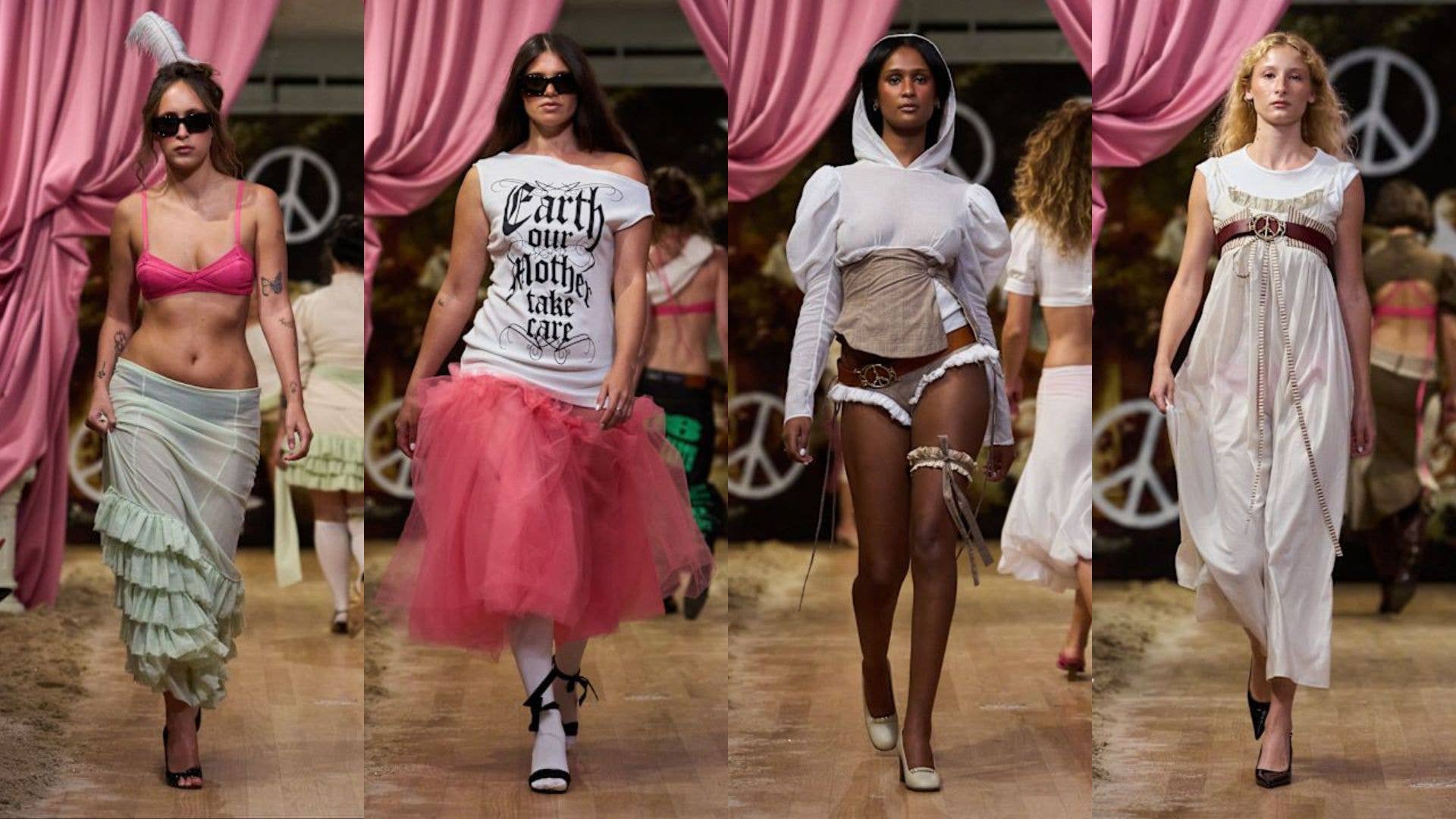
Ella Mae Jepsen pulled off one of New York Fashion Week's most audacious conceptual mashups, fusing rococo excess with early-2000s club culture for her Spring 2027 debut. The Los Angeles-based designer channeled Marie Antoinette's architectural silhouettes alongside Snooki's spray-tanned, bedazzled aesthetic, creating a collection that thrived on contradiction and spectacle.
The collection represented maximalism at its most unhinged. Jepsen layered 18th-century volume onto modern bodies, reconstructing the exaggerated panniers and structured bodices of Versailles through a distinctly contemporary lens. She paired these historical references with the garish metallics, animal prints, and logo saturation that defined Jersey Shore glamour circa 2009. Rhinestone-encrusted pieces sat next to powder-blue fabrics. Corsetry merged with low-rise silhouettes. Nothing whispered. Everything screamed.
This collision course between high fashion history and pop culture kitsch speaks to a broader shift in how emerging designers approach luxury. Rather than chase restraint or minimalism, younger brands embrace irony, nostalgia, and cultural hybridity as tools for commercial relevance. Jepsen's work joins designers like Moschino and Dolce & Gabbana in treating fashion as cultural commentary and costume simultaneously. The difference: she paired her references with technical construction, not just concept.
The Y2K revival has dominated runways for three seasons. Designers from Versace to Blumarine have mined that era for its color saturation and body-conscious cuts. What distinguishes Jepsen's approach is the deliberate ugliness. She didn't sanitize the Jersey Shore references or soften them with irony. Instead, she honored what made that era visually transgressive, then elevated the construction without apologizing for the source material.
Marie Antoinette offers a historical parallel worth noting. The French queen became a symbol of excess, indulgence, and willful disregard for restraint. Snooki embodied similar qualities two centuries later, transformed into a tabloid figure through her unapologetic commitment to spectacle. By positioning them as aesthetic equals, Jepsen suggests that maximalism transcends class and era. Excess speaks a universal language.
For retailers and buyers, this collection signals demand for pieces that read as statement-making without requiring a sense of humor or irony from the wearer. Younger consumers increasingly reject the "quiet luxury" directive, instead seeking garments that declare their presence and personality. Jepsen's work answers that demand with technical sophistication backing the visual excess.
The designer's NYFW debut also reflects a shift in where fashion innovation originates. Los Angeles has emerged as a serious alternative to New York and Paris for boundary-pushing ready-to-wear. Brands developed on the West Coast tend toward boldness and commercial energy, prioritizing immediate visual impact over subtle refinement. Jepsen fits that lineage while adding her own historical research layer.
Spring 2027 delivery positions the collection for immediate retail pickup. Specialty boutiques catering to younger, fashion-forward customers will likely prioritize pieces that deliver the most theatrical silhouettes. The real test arrives in how Jepsen scales the collection for broader distribution without losing the intentional excess that defined the NYFW presentation.
Her debut announced Jepsen as a designer uninterested in earning her maximalist credentials gradually. She arrived fully formed, confident in her references, and committed to a vision that celebrates rather than apologizes for grandeur.