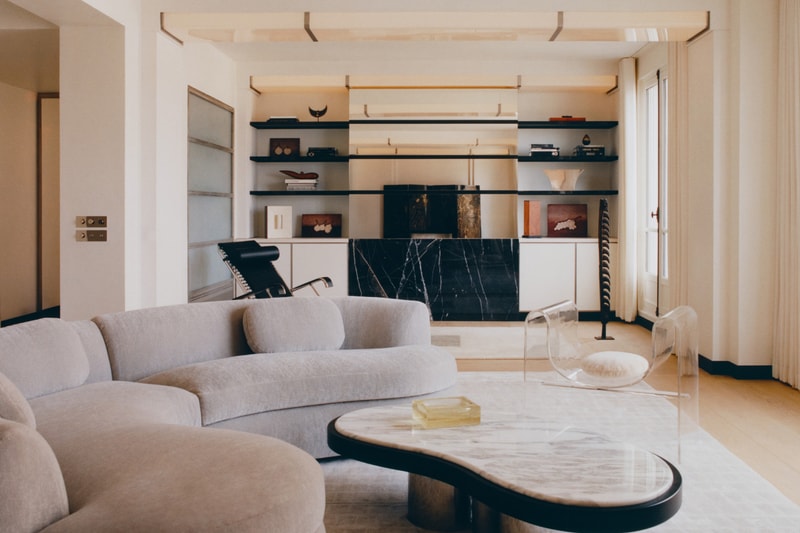
Rudy Guénaire unveiled his latest residential design in a 1920s Parisian building overlooking Place du Panthéon, creating an apartment that anchors itself in timeless materials and craftsmanship rather than fleeting trends.
The space spans the penultimate floor, commanding views toward the Panthéon dome through its position above Paris's iconic zinc roofscape. Guénaire built the interior around boldness and restraint working in tandem. Six-meter-long German oak flooring establishes the foundational narrative, while steel marquetry inspired by Gae Aulenti's modernist vocabulary adds graphic precision to surfaces. This references the Italian designer's sculptural approach to interiors without mimicking it directly.
Furniture selections lean into craft over convention. Bespoke pieces with Brazilian influences populate the living spaces, bringing warmth and sculptural form to rooms defined by geometry and light. The bathroom departs from restraint entirely. Iranian onyx finishes command the space, their veining and depth transforming a functional room into a material statement. This moment of chromatic intensity contrasts sharply with the apartment's predominantly neutral palette elsewhere.
Guénaire's design philosophy centers on creating spaces "that exist outside of time," rejecting the seasonality that typically defines residential interiors. He achieves this through material selection and proportion rather than decoration. The apartment reads as inhabitable art, where every surface carries intention. The view becomes part of the design itself. Rather than compete with the Panthéon's grandeur, the apartment acts as a frame for it.
The project sits within a broader movement toward what might be called "timeless maximalism" in luxury residential design. Contemporary designers increasingly reject both sterile minimalism and trend-chasing maximalism, instead pursuing a middle path where materials, craft, and view take precedence. Guénaire