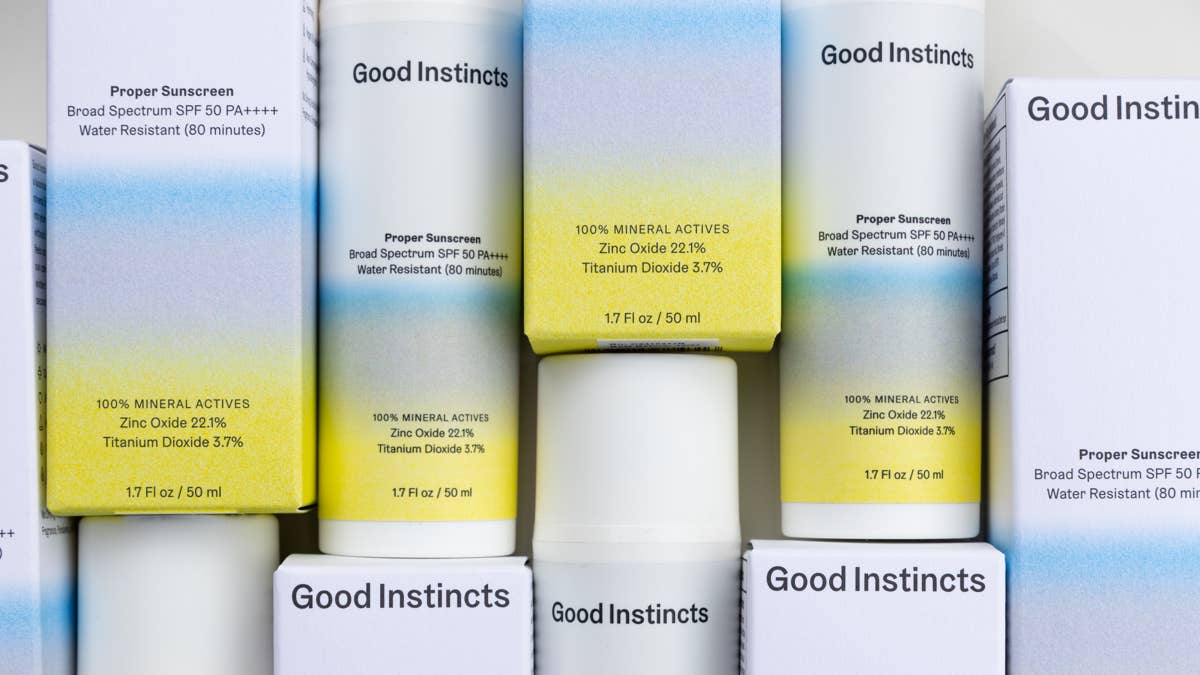
Good Instincts entered the mineral sunscreen market in 2025 with backing from former tech executives who identified a gap in lightweight sun-care formulation. The brand centers on a zinc oxide-based SPF that clocks in at approximately 22.1% zinc oxide, positioning itself against the chalky, heavy textures that have long plagued mineral sun protection.
The founding team's tech background shapes the brand's approach. Rather than relying solely on beauty industry expertise, Good Instincts applied product development rigor and consumer data analysis to reformulate mineral sunscreen from scratch. This outsider perspective targets a specific frustration. Consumers have gravitating toward chemical sunscreens for years because mineral options felt pasty and left white casts on skin, particularly on deeper complexions.
The 22.1% zinc oxide concentration represents the chemistry behind Good Instincts' differentiation. Zinc oxide sits at the heart of mineral sun protection, but achieving a cosmetically elegant formula requires precision in particle size and suspension chemistry. Good Instincts appears to have cracked the texture problem that legacy brands struggled with for decades.
The brand arrives at a pivotal moment for sun care. Clean beauty and reef-safe formulations have become non-negotiable for consumers, pushing mineral options from niche to mainstream. Brands like Blue Lizard, Neutrogena's Sheer Zinc line, and Coppertone's mineral range now compete openly with chemical leaders. Good Instincts slots into an increasingly crowded but expanding category.
The tech-founder trend in beauty continues accelerating. Founders from engineering and software backgrounds bring operational efficiency and data-driven marketing that challenges traditional beauty incumbents. Good Instincts' launch strategy likely leverages direct-to-consumer channels and precision targeting rather than traditional retail distribution.
Success hinges on whether the formula delivers on the lightweight