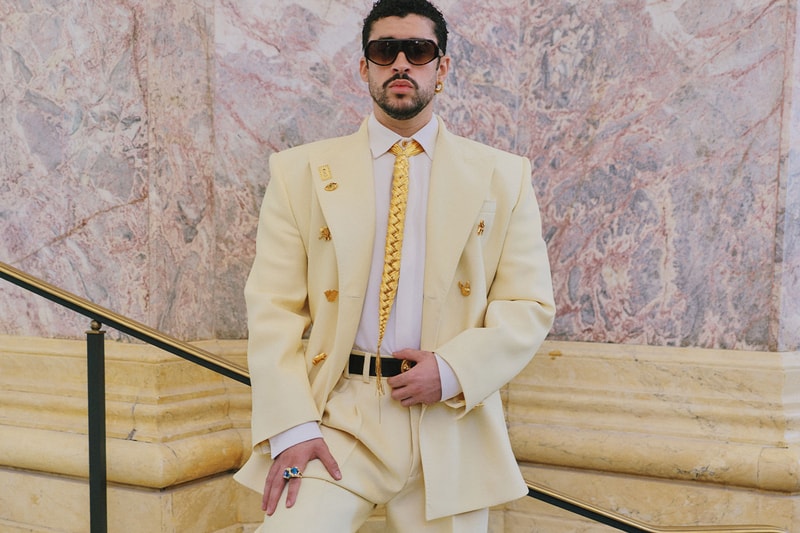
Bad Bunny commanded the Schiaparelli Haute Couture Fall-Winter 2026/27 presentation in Paris with a custom butter-yellow suit that blended high fashion with personal iconography. The Grammy winner wore a bespoke creation featuring brand-specific details and brooches referencing his own album history, transforming the runway moment into a cultural statement rather than a simple front-row appearance.
Designer Daniel Roseberry crafted the piece around Bad Bunny's aesthetic sensibilities. A glossy mock croc cowboy belt anchored the silhouette, paired with a striking gold braided tie and custom black leather cowboy boots. The combination married Schiaparelli's surrealist DNA with Bad Bunny's reggaeton-inflected maximalism, creating something neither house nor artist could achieve alone.
This represents a shift in haute couture's celebrity positioning. Rather than passive endorsement, Bad Bunny became a creative collaborator, embedding his discography into haute couture construction. Schiaparelli gains cultural currency beyond traditional fashion media. Bad Bunny asserts his dominion over cultural spaces that once excluded him, whether runway or atelier.
The move reflects luxury's current reckoning with pop culture. Houses like Schiaparelli increasingly court musicians and entertainers not as models but as creative partners. Custom pieces for cultural icons generate the kind of organic visibility that traditional advertising cannot replicate. Bad Bunny's appearance generates headlines, social media saturation, and conversation that justifies the investment.
Paris Fashion Week has become as much about celebrity moments as designer vision. When superstars attend, they don't simply wear clothes. They perform alignment. Bad Bunny's custom Schiaparelli moment positioned him within haute couture's institutional framework while maintaining his outsider credibility. That balance demands rare execution.
The butter-