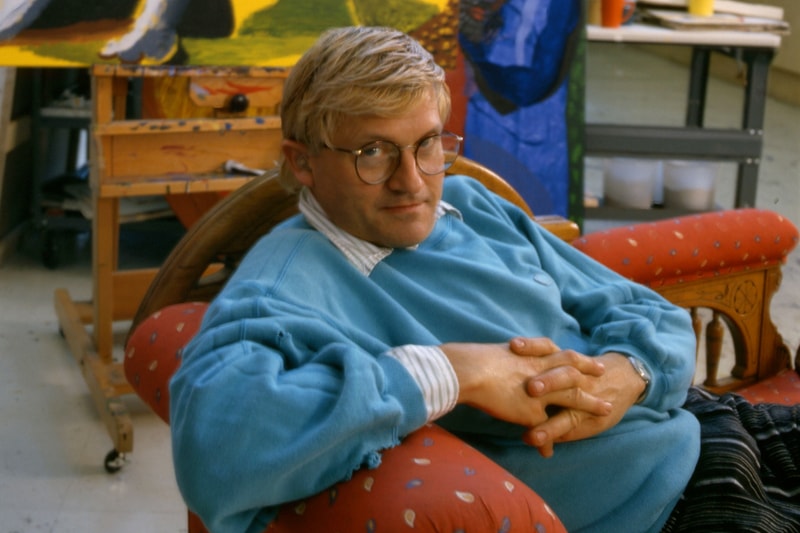
David Hockney, the British painter who defined pop-art sensibility with his luminous pools, intimate portraits, and radical experimentation across mediums, died on June 11 at age 88 in his home.
Hockney's influence extended far beyond fine art into fashion and visual culture at large. His fearless use of color, composition, and perspective shaped how an entire generation of designers approached aesthetics. The artist rejected the notion that art existed in isolation. Instead, he treated painting as a living, evolving conversation with the world around him.
Born in Bradford in 1937, Hockney trained at Bradford School of Art before studying at the Royal College of Art in London, where he quickly emerged as a radical voice in British postwar art. His early works challenged conventions, blending figuration with abstraction in ways that unsettled and captivated audiences simultaneously. He moved between painting, photography, printmaking, and digital media with the ease of someone who viewed boundaries as invitations rather than barriers.
His iconic pool paintings from the 1960s became cultural touchstones, their glittering surfaces and geometric precision influencing everything from interior design to haute couture aesthetics. Designers from Valentino to contemporary streetwear labels drew inspiration from Hockney's chromatic fearlessness and his ability to find profundity in surfaces that appeared purely decorative.
Throughout his career, Hockney maintained that art could transform perception itself. He believed beauty existed even in darkness, a philosophy that resonated with fashion's own cycles of reinvention and visual storytelling. His later digital works proved that innovation remained central to his practice even as he aged, refusing the comfortable repetition that claims many established artists.
Hockney's death marks the end of a singular artistic voice that shaped postwar visual culture. His legacy lives on in the work of designers and