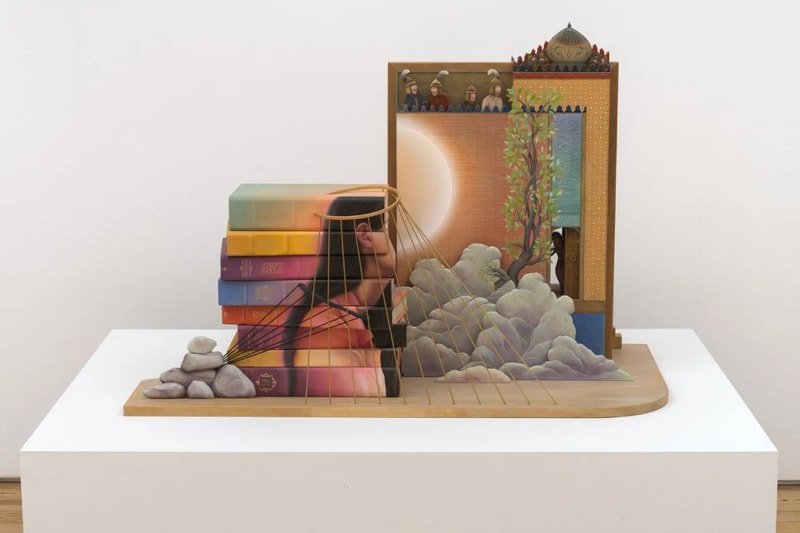
Iranian artist Arghavan Khosravi stages a major evolution at Uffner & Liu in New York with "What Remains," her third solo with the Manhattan gallery running through July 2, 2026. The exhibition centers on multi-paneled sculptural canvases and an entirely new Altar Series, marking a decisive shift in her diasporic visual language.
Khosravi's work fuses Persian miniature traditions with surrealist and mixed-media techniques, creating densely layered compositions that speak to displacement, memory, and cultural inheritance. The sculptural canvases function as three-dimensional objects rather than flat surfaces, a formal choice that amplifies the immersive quality of her practice. This dimensionality transforms the gallery space into an environment of contemplation rather than passive viewing.
The Altar Series introduces spiritual and domestic frameworks into Khosravi's vocabulary. These works reference both Iranian domestic interiors and contemporary altar-making practices, positioning them as sites where personal and collective trauma intersect. By invoking the altar form, Khosravi grounds her diasporic narratives in ritual and reverence, acknowledging how artists from displaced communities construct meaning through material and memory.
Khosravi's engagement with Persian miniature aesthetics positions her within a broader contemporary conversation about decolonizing art histories and centering non-Western visual traditions. Rather than treating Persian forms as historical reference points, she metabolizes them into her surrealist practice, creating a hybrid vocabulary that refuses singular cultural categorization. This approach resonates with the current moment, where diaspora artists increasingly assert agency over their own iconographies and resist flattening narratives about "cultural authenticity."
The exhibition arrives as galleries nationwide sharpen focus on emerging voices interrogating identity, belonging, and what persists after displacement. Khosravi's work operates at the intersection of materi