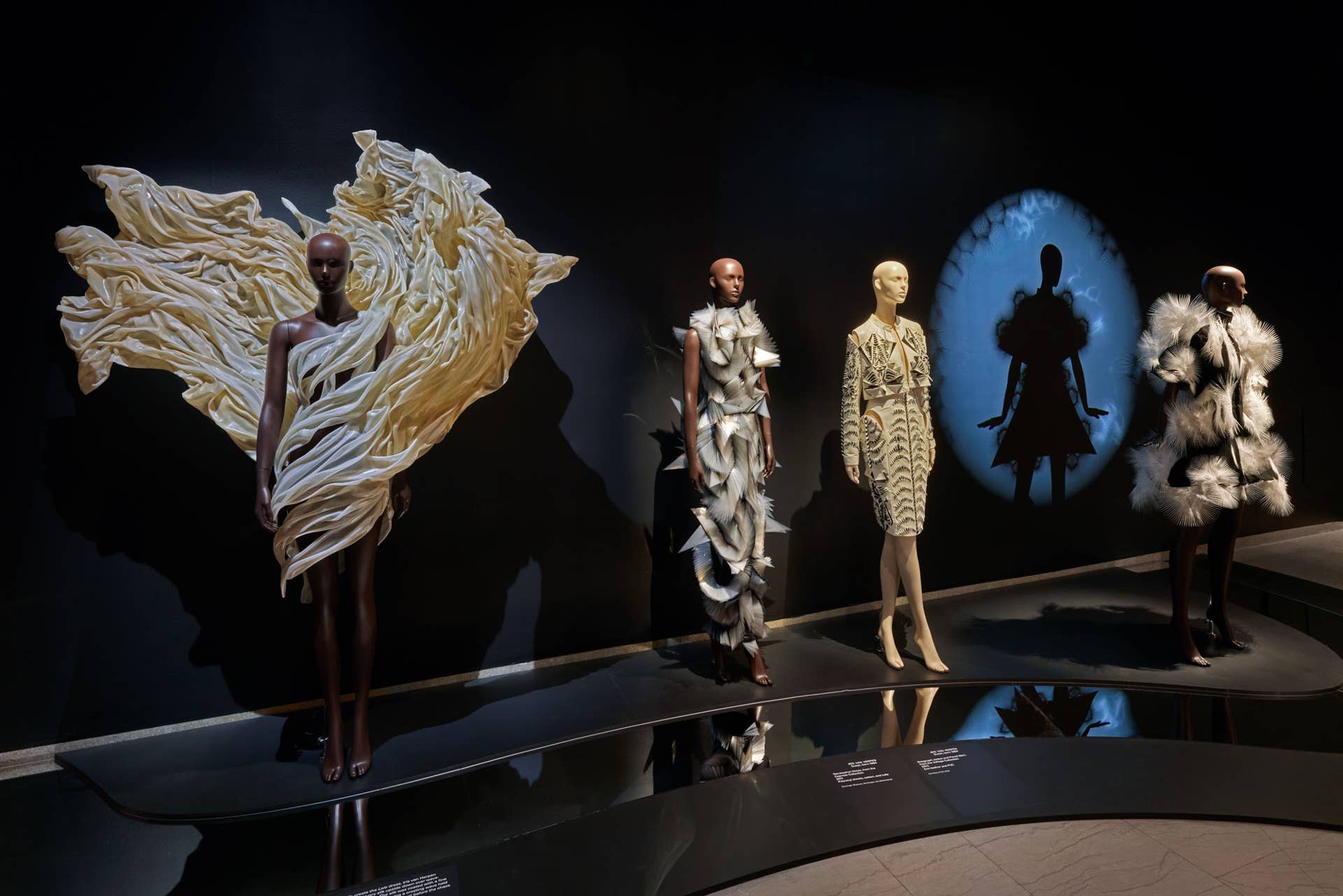
Iris Van Herpen's retrospective at the Brooklyn Museum positions the Dutch couturier as fashion's most ambitious practitioner of biomimicry and structural innovation. "Sculpting the Senses" traces the designer's evolution from her early experiments with 3D printing to her latest explorations of fluid dynamics and architectural geometry.
Van Herpen built her practice on collaboration with scientists, engineers, and architects rather than traditional pattern makers. Her 2010 collection integrated 3D-printed components that looked like exoskeletons; her 2012 show featured garments inspired by water molecules and capillary action. These weren't gimmicks. Each piece emerged from rigorous research into how materials move, how bodies occupy space, and how technology can expand the vocabulary of couture.
The exhibition reveals Van Herpen's method. Sketches sit alongside prototypes and finished garments, showing how she translates scientific concepts into wearable sculpture. A dress inspired by frost crystallization appears alongside documentation of actual ice formations. Collaborations with MIT researchers and biomimicry specialists explain the intellectual rigor beneath the visual drama.
This matters because Van Herpen has redefined what haute couture can be. While luxury houses dabbled in digital presentation, she fundamentally reconceived the relationship between body, material, and form. Her work sits between fashion and fine art, between runway spectacle and laboratory experiment.
The retrospective arrives at a moment when the industry grapples with sustainability and innovation. Van Herpen's approach, while resource-intensive, models how technology can challenge conventional construction. Her garments demand reconsideration of what a designer's role encompasses. She's not just styling bodies; she's engineering them.
The Brooklyn Museum show runs through spring 2024 and features approximately 50 pieces spanning two decades. It confirms Van Herpen's status as