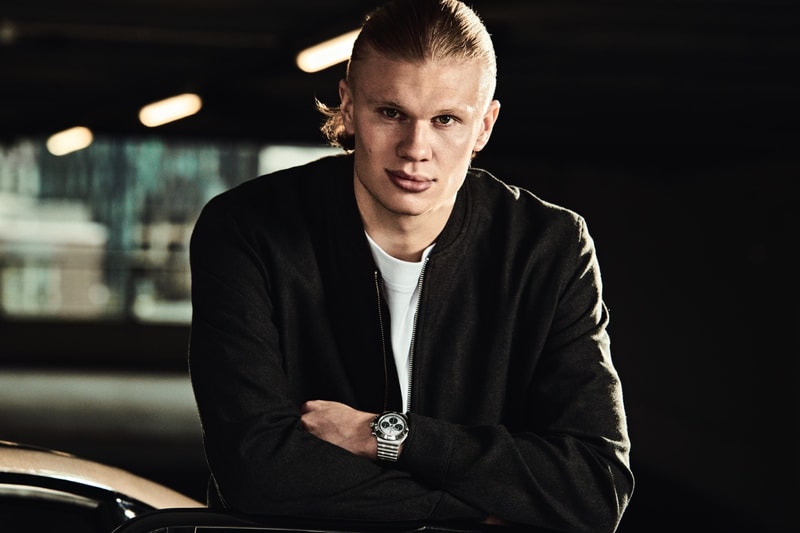
Breitling resurrects its legendary Chronomat chronograph, the Swiss watchmaker's defining sports instrument born from an impossible 1980s brief. When Ernest Schneider challenged Italy's Frecce Tricolori aerobatics team to engineer a timepiece capable of withstanding 20G forces while maintaining formal dinner polish, the 1984 result became iconic. The Chronomat bridged cockpit precision and wrist elegance, merging "chronograph" and "automatic" into a watch that demanded both technical mastery and aesthetic refinement.
The relaunch taps Manchester City's Erling Haaland as its ambassador, a casting that speaks to Breitling's repositioning. Haaland embodies the modern athlete-icon wearing watches as cultural statements rather than functional tools. His association elevates the Chronomat beyond horological circles into broader luxury and sports culture.
This revival arrives as the luxury watch market contends with younger demographics favoring accessible alternatives and digital timekeeping. Breitling's strategy pairs heritage credibility with contemporary relevance through athlete endorsements and lifestyle positioning. The Chronomat's reintroduction signals confidence in analog watches' staying power among aspirational consumers who view mechanical timepieces as status symbols and engineering poetry.
The timing matters. Sports watches have dominated luxury watch discourse for five years, with Rolex Sports Models and Omega's racing collaborations commanding waiting lists. Breitling positions the Chronomat as a competitor in this space, leveraging its genuine aviation lineage against newer entrants. Haaland's selection acknowledges this shift. Unlike traditional watch ambassador casting of older, established figures, his youth and athletic prominence signal that mechanical watches remain desirable to the next generation.
The Chronomat's original design philosophy, balancing instrument and statement piece, remains relevant. Br