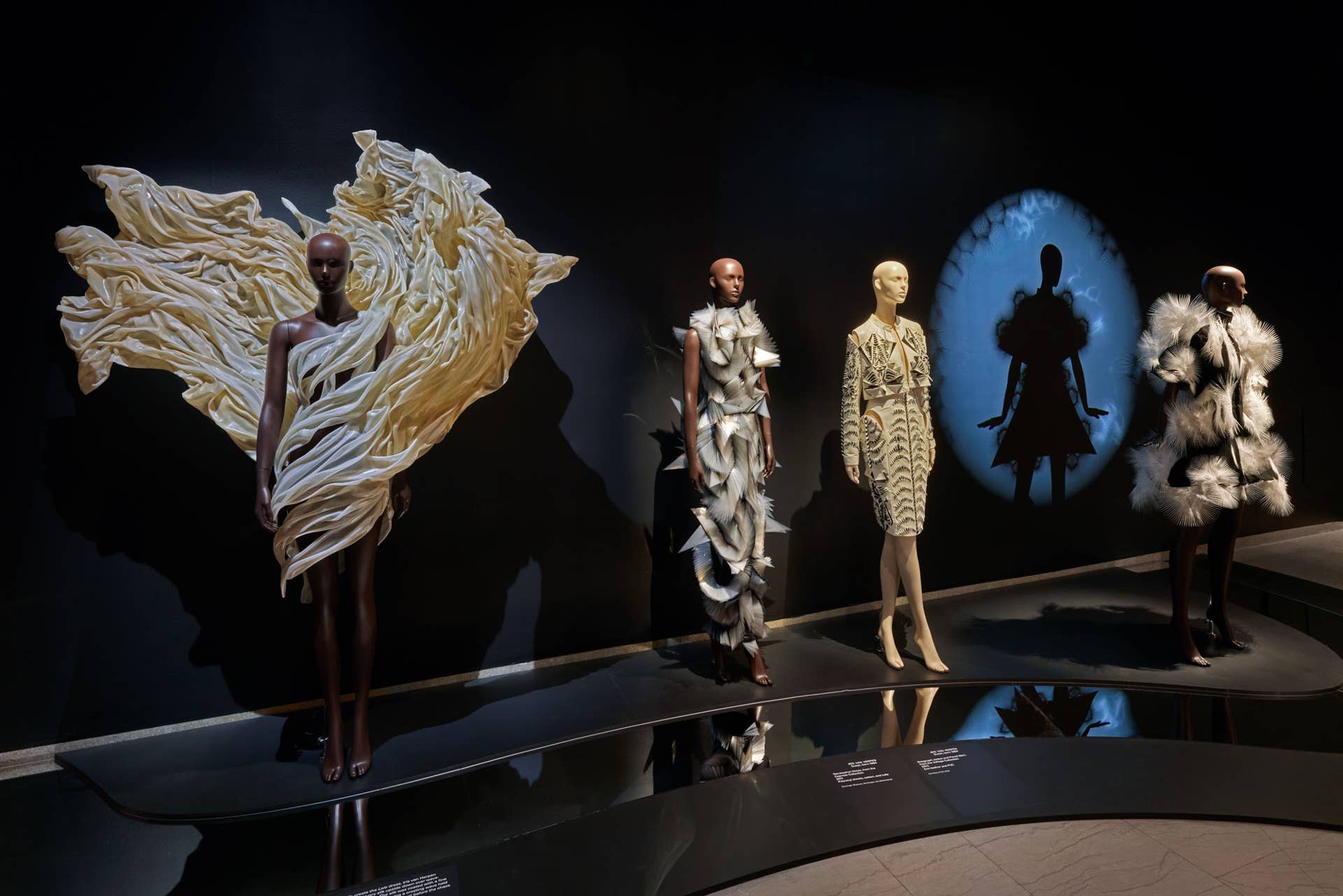
Iris Van Herpen's "Sculpting the Senses" exhibition at the Brooklyn Museum opens a window into the Dutch designer's methodical approach to haute couture. The mid-career retrospective traces Van Herpen's evolution from conceptual sketches to finished pieces, revealing her systematic integration of scientific principles with pure artistic vision.
Van Herpen has built her reputation on radical silhouettes that challenge conventional garment construction. Her work employs biomimicry, 3D printing, and architectural frameworks to create pieces that exist at the intersection of fashion, sculpture, and technology. The exhibition catalogs how she translates natural forms, mathematical patterns, and engineering concepts into wearable art.
The show documents Van Herpen's most pivotal collections, including her landmark pieces that introduced digital fabrication to luxury fashion. Rather than presenting finished garments in isolation, the exhibition displays research materials, maquettes, and prototypes alongside final creations. This curatorial choice exposes the labor-intensive thinking that defines her practice.
Van Herpen's work arrives at a moment when high fashion increasingly engages with scientific and technological innovation. Her pieces reject the minimalist reduction that dominates luxury design, instead embracing volumetric complexity and structural audacity. Each silhouette reads as a three-dimensional problem solved through material experimentation.
The Brooklyn Museum exhibition positions Van Herpen within fashion's avant-garde lineage while acknowledging her distinct contribution. She operates neither as a pure technologist nor a traditional couturier, but as a designer fluent in both disciplines. Her pieces demand to be experienced in person, their dimensionality and surface intricacy impossible to fully comprehend through photography.
The retrospective arrives as Van Herpen continues producing seasonal collections that push into unexplored territory. Her influence extends across the industry, with other designers and houses adopting methodologies she pioneered