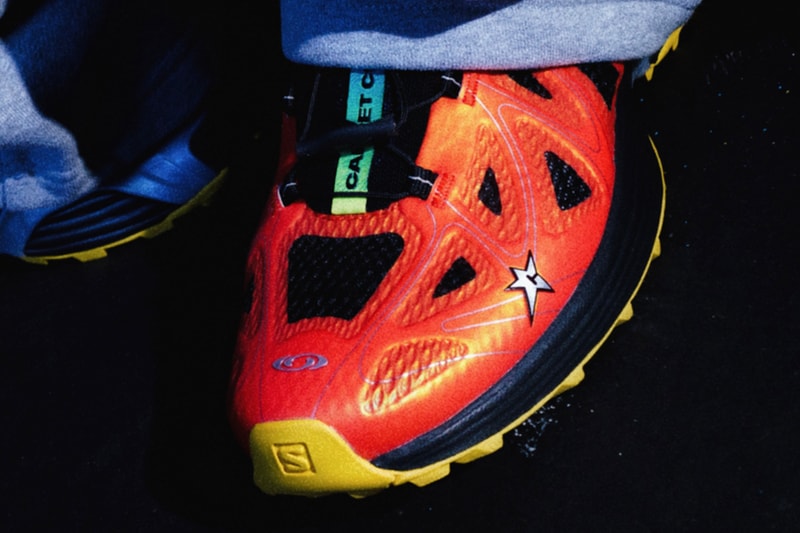
Salomon and Baltimore skate institution Carpet Company have produced a collaboration that transforms the XT-Whisper Void into a statement piece. The partnership marks a collision between performance footwear engineering and independent skate aesthetics, two worlds rarely aligned with such intentionality.
The design channels Carpet Company's "Habibi Express," a modified 1995 Honda Acty Street van that functions as both brand symbol and mobile headquarters. High-gloss red finishes dominate the upper, paired with iridescent TPU detailing that shifts between metallic tones. The execution feels automotive-inspired without descending into literal novelty. Every element serves the silhouette rather than overwhelming it.
What elevates this release beyond standard collaboration territory is the production restraint. Salomon produced exactly 1,720 individually numbered pairs globally. The figure doubles as geography. It references 1720, the address of Carpet Company's Baltimore warehouse where the Habibi Express lives. This kind of hyperlocal specificity roots the shoe in actual place and narrative rather than abstract branding.
Carpet Company operates in the margins of contemporary skate culture. The brand resists the corporate streamlining that has consumed most skateboard companies over the past decade. Their partnerships feel earned rather than transactional. A Salomon collaboration signals how outdoor performance brands increasingly recognize that credibility now flows from skate and street communities, not the reverse.
The XT-Whisper Void itself carries technical DNA from Salomon's trail-running heritage. Pairing this utilitarian foundation with Carpet Company's visual language creates productive tension. You get performance geometry filtered through independent skate sensibility.
Limited drops numbered this conservatively typically sell through within hours. The restrictive production run transforms a shoe into object, elevating perceived value through genuine scarcity rather than artificial gatekeeping